

Menu
Scattered signals organising into a framework and leaving as clear direction
Our frameworks

Built for change.

Markets move. Consumers evolve. Businesses adapt. Our frameworks give structure to change — so a decision still holds up after the market shifts again.

Explore our frameworks →
Many signals.Complexity in the real world.
›
Structured insight.Meaningful connections.
›
Stronger decisions.Sustainable impact.

Proprietary frameworks.
One integrated approach.

One reads the brand over time. One reads it from every side at once. One reads whether a business can endure and still be chosen. One reads a market in transition through the people moving through it. Each answers a different question — and they are built to be used together.

4E is MaLogic’s proprietary brand management framework.

MaLogic 4E helps a brand evaluate where it really stands, enforce a clear and consistent promise, deepen engagement, and keep enhancing itself for sustainable growth. Research and brand development run on one platform, with one team, from the first question to the final recommendation.

It answers: Is our brand still earning its position?

A blueprint for unlocking a brand's potential — and keeping it competitive in a market that will not sit still.

360 Branding is MaLogic’s proprietary framework for holistic brand evaluation and development.

MaLogic 360 Branding evaluates a brand from every critical perspective — inside and out — to uncover opportunities, strengthen positioning and manage risk. It forms the basis of our 360° brand health check and the work that follows: identity design and formulation, active brand lifecycle management, integrated brand communications, internal brand alignment and brand rejuvenation.

It answers: Where are we actually losing ground?

ConsumerNeeds, perceptions, behaviours
CultureSociety, trends, values
CompetitorLandscape, moves, differentiation
CompanyStrategy, capability, resources
Consumer

What people need, what they believe about the brand, and what they actually do — rarely the same thing.

Company

What the business can credibly deliver: strategy, capability, resources, and the gap between promise and operation.

Competitor

Where the category is moving, who is moving it, and what genuinely separates this brand from the field.

Culture

The wider shifts in society, values and expectations that decide whether a brand still feels relevant.

A complete view — to identify white space, strengthen advantage and make confident decisions.

SURVIVE × CHOICE

Structural endurance meets
decision priority.

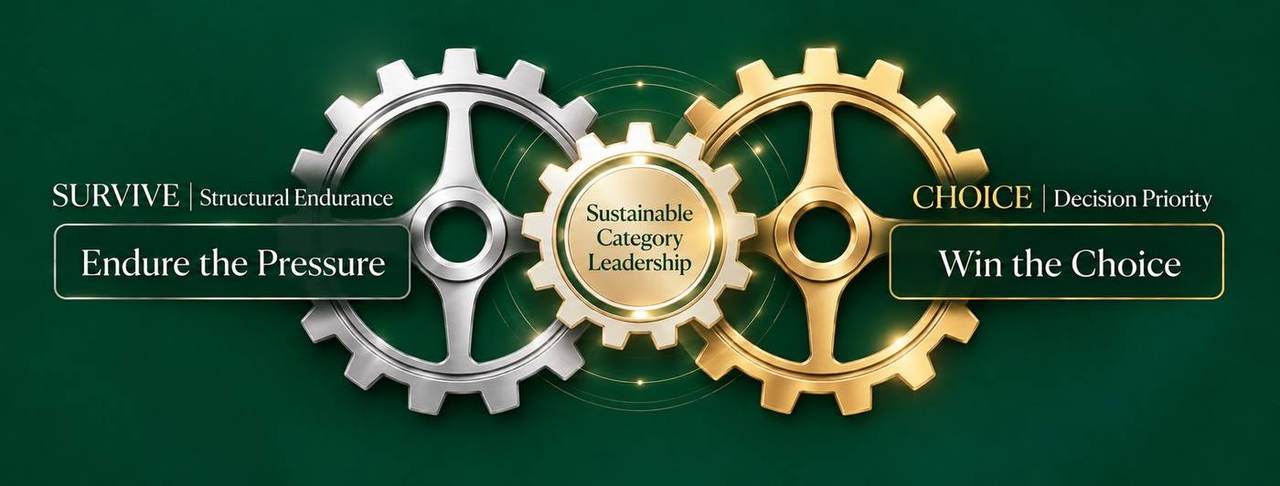
SURVIVE × CHOICE is MaLogic’s proprietary two-lens framework for diagnosing structural endurance and consumer decision priority.

In markets where growth can no longer be taken for granted, performance depends on two fundamentally different strengths: structural endurance from the inside out, and decision priority from the outside in.

One framework. Different decision dynamics.

The two lenses stay constant. What they assess — and the relative emphasis between them — adapts to the category and decision environment.

Different decision environments place different demands on the same underlying framework. Lower-involvement decisions tend to place greater emphasis on habit, immediacy and ease of choice, while higher-involvement decisions place greater emphasis on trust, justification, comparison and decision confidence.

SURVIVE — Inside-out Structural Endurance, endure the pressure; Endurance Capital, win the choice; together, sustainable category leadership
SURVIVE
Inside-out structural endurance

Can the business absorb sustained pressure?

SURVIVE examines the structural strength of the business from the inside out — whether its scale, economics, route to market, value architecture, integration, velocity and capital endurance are strong enough to withstand sustained competitive pressure.

It asks whether the business is built to endure.

CHOICE
Outside-in decision priority

Will the market choose it when it matters?

CHOICE examines the market from the outside in — whether customers see enough relevance, justification, confidence and meaning to prioritise the brand over credible alternatives in a real decision context.

It asks whether structural capability translates into choice.

How the same structure adapts The dimensions stay anchored. What they assess adapts to the category and decision environment.
DimensionLower-Involvement DecisionsHigher-Involvement Decisions
SURVIVE — Inside-out Structural Endurance
S Scale ResilienceScale efficiency, utilisation and demand absorptionProductive scale, capacity utilisation, diversification and structural buffers
U Unit EconomicsTransaction economics, contribution and operating leverageUnit margin, profitability, cash conversion and commitment economics
R Route to MarketAvailability, channel reach, delivery efficiency and convenienceChannel effectiveness, conversion, service coverage and market access
V Value ArchitectureCost-to-value configuration and monetisationAssets, capabilities, cost structure and value-capture architecture
I Integration StrengthCoordination across supply, operations, channels and serviceControl and coordination of critical capabilities and systems
V VelocitySpeed of response, offer refresh and operational adaptationProduct, technology and organisational iteration without excessive cost or risk
E Endurance CapitalFinancial capacity to absorb volatility and operating pressureCapital capacity to sustain long cycles, investment and structural pressure
CHOICE — Outside-in Decision Priority
C Contextual LegitimacyContext FitContextual Legitimacy
H Heuristic RecallHabit StrengthHeuristic Recall
O Occasion AuthorityOccasion OwnershipOccasion Authority
I Investment JustificationImmediate ValueInvestment Justification
C Comparative SafetyCompetitive ContrastComparative Safety
E Enduring MeaningEmotional PayoffEnduring Meaning
The dimensions stay anchored — and the weight of the two lenses can also adapt.

The two lenses need not be 50:50. Industry structure determines the weighting. Heavy structural commitments make SURVIVE the first-order question. Where assets are lighter and switching is more fluid, CHOICE can create greater competitive separation.

Why the two lenses belong together

A business can be structurally strong yet less chosen. A brand can be desirable yet lack resilience. Either side alone can mislead.

SURVIVE reveals whether the business can withstand pressure. CHOICE reveals whether structural capability translates into priority choice. Together, they show where competitive strength is genuinely sustainable — and where apparent performance may be masking vulnerability.

Where logic meets magic

SURVIVE is grounded in the logic of structural endurance — scale, economics, route to market, value architecture, integration, velocity and endurance capital. CHOICE captures the outside-in dynamics behind decision priority — relevance, justification, confidence and meaning.

Logic builds the foundation.
Magic creates preference.
Sustainable advantage requires both.

When to use it
Mature or low-growth marketsStructural disruption Intensifying competitionChanging consumer priorities Margin pressureBrand portfolio decisions Category transformation

It can be applied at company, brand, portfolio or competitive-set level, combining business evidence with consumer research to identify where strength is durable, where choice is shifting, and where management action matters most.

See the framework in action
ICIC

Understand today's consumers.
Shape tomorrow's mobility.

ICIC is MaLogic’s proprietary consumer intelligence framework for understanding choice and conversion in China’s intelligent vehicle market.

ICIC — Insights on Consumer Intelligent Vehicle Conversion. The shift to electric and intelligent vehicles is more than a change in powertrain. It is reshaping what cars mean in people’s lives — and changing how consumers discover, evaluate and choose them.

ICIC — advanced big data insights for the New Energy Vehicle market in China

ICIC combines large-scale behavioural data with consumer insight to uncover the people, motivations and behaviours behind the transition to new mobility.

Using consumer spending data, app-usage information and advanced analytics, ICIC profiles passenger vehicle owners and NEV buyers, revealing consumption patterns and behavioural signals that conventional research alone may not capture.

From awareness and consideration through to purchase, ICIC helps businesses understand the complete consumer journey and translate complex data into clearer strategic direction.

ICIC helps inform
Consumer profiling
Understand who NEV buyers are beyond conventional demographics.
Behaviour & lifestyle
Reveal broader spending, digital and consumption patterns.
Customer journey
Track the path from awareness and consideration to purchase.
Targeting & communication
Identify meaningful audiences and how best to engage them.
Product & brand strategy
Turn behavioural intelligence into actionable opportunities.

Big data. Human understanding.
Clearer pathways forward.

See the framework in action The ICIC series — four white papers China’s intelligent vehicle market seen from the consumer side — market development, consumer segmentation, the new notion of premium and the conditions for the next phase of adoption →
Magic sparks possibility.
Logic makes it real.

Our teams are research people and brand people working as one project team, from the first question to the final recommendation. That is not a staffing preference — it is the reason the frameworks work. After all, re-branding is about both science and art combined.

Ready to build stronger brands?

Tell us the decision you're facing. We'll tell you how we'd structure it.

Start a conversation →